• About the Blogger
  • Healthcare Disclaimer

Fit Past 40 Blog

~ Tips to stay fit, healthy, and young-looking

Fit Past 40 Blog

Tag Archives: Exercises

Yoga vs. Mat Pilates: Choosing the Right Path to Mind-Body Wellness

03 Friday Nov 2023

Posted by Adriana Falco in Anti-Aging, Pilates, Yoga

≈ Leave a comment

Tags

Exercises, Fitness, Health, Pilates

In the world of mind-body fitness, two popular disciplines have stood the test of time and gained immense popularity among fitness enthusiasts: yoga and mat Pilates. Both of these practices offer a holistic approach to improving physical and mental well-being, but they do so in distinct ways. In this post, I will explore the key differences and benefits between the two, helping you make an informed decision about which one suits your needs and preferences best.

Yoga: Mind-Body Connection and Balance

Yoga is an ancient practice originating in India that combines physical postures, breath control, and meditation to foster holistic well-being. It is a more comprehensive system compared to mat Pilates, with a focus on the mind-body connection.

Key characteristics of yoga include:

  • Mindfulness and Meditation: Yoga encourages mindfulness and meditation, offering a mental and emotional dimension to physical practice. Through breath control and meditation techniques, practitioners develop mental clarity and stress reduction.
  • Variety of Styles: There are numerous styles of yoga, ranging from vigorous and dynamic practices like Vinyasa and Ashtanga to gentler styles like Hatha and Yin. This variety allows individuals to choose the style that suits their physical fitness and mental needs.
  • Flexibility and Balance: Yoga emphasizes flexibility, balance, and overall body strength. It involves a wide range of poses and stretches that target various muscle groups and help improve posture and alignment.
  • Connection to Spirituality: Some forms of yoga, such as Bhakti and Kundalini, incorporate elements of spirituality and self-realization. These practices delve deeper into the connection between the physical body and the spiritual self.

Benefits of Yoga

  • Enhanced flexibility, balance, and strength.
  • Stress reduction and mental clarity.
  • Improved posture and body awareness.
  • A sense of inner peace and self-connection.
  • Adaptability to various fitness levels and goals.


Mat Pilates: Core Strength and Precision

Mat Pilates, often referred to as Pilates, is a low-impact exercise method developed by Joseph Pilates in the early 20th century. It focuses on strengthening the core muscles, enhancing flexibility, and promoting body awareness.

Key characteristics of m Pilates include:

  • Core Emphasis: Mat Pilates places a strong emphasis on core strength. Exercises primarily target the abdominal muscles, lower back, hips, and glutes. The controlled, precise movements in Pilates engage the core throughout the workout, resulting in improved stability and posture.
  • Equipment-Free: Unlike its apparatus-based counterpart, mat Pilates requires minimal equipment. All you need is a comfortable mat or a padded surface, making it an accessible and cost-effective option for many.
  • Precision and Control: Pilates exercises demand a high degree of precision and control. Each movement is performed with a focus on proper alignment and breath, which not only strengthens the body but also enhances mental concentration.
  • Versatility: Mat Pilates can be tailored to different fitness levels, making it suitable for beginners and advanced practitioners alike. As you progress, you can add props like resistance bands, stability balls, or small hand weights to intensify your workouts.

Benefits of Mat Pilates

  • Improved core strength and stability.
  • Increased flexibility and range of motion.
  • Enhanced posture and body awareness.
  • Reduced risk of injury through proper movement mechanics.
  • Stress reduction and improved mental clarity.
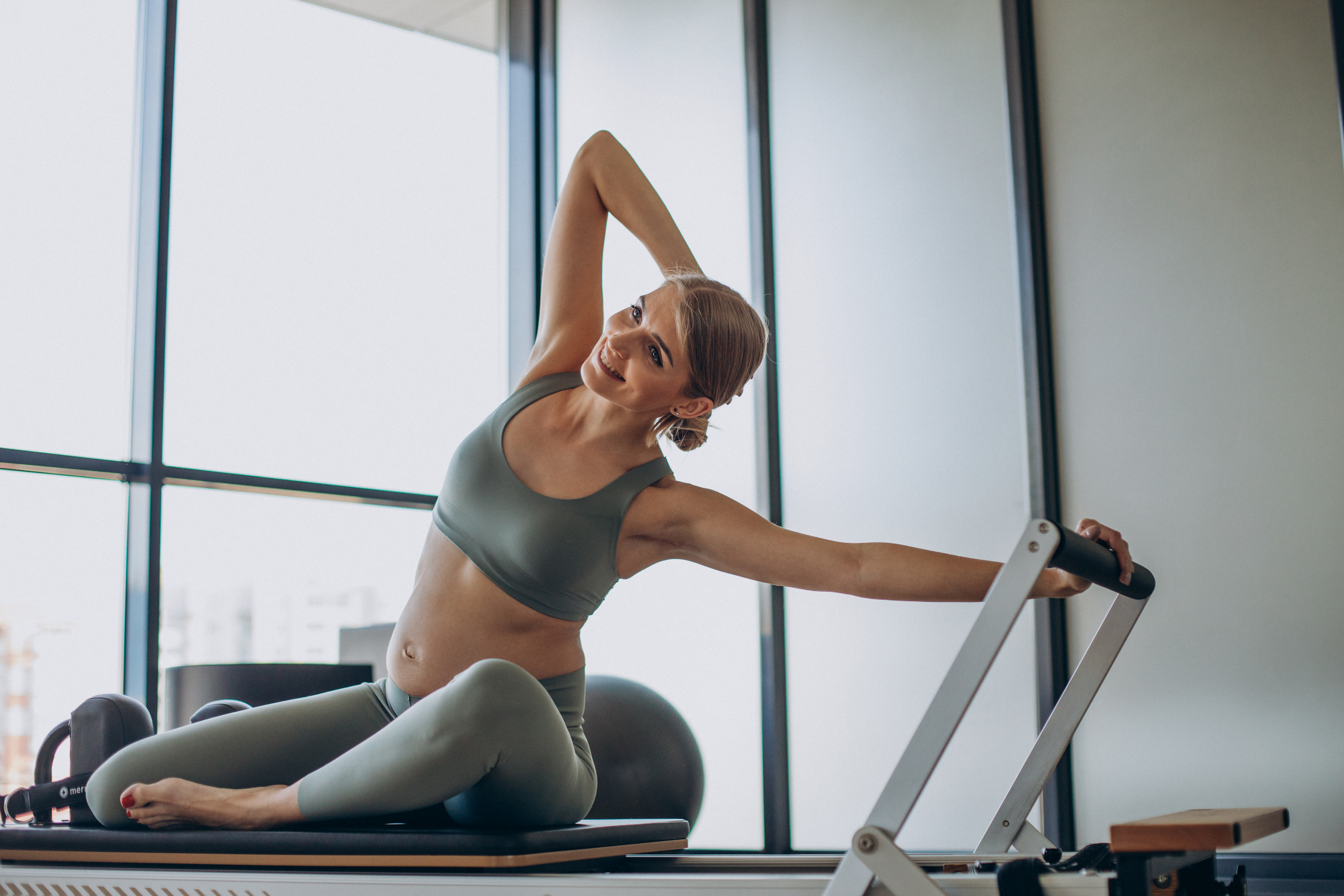

Apparatus Pilates

For those wondering about Pilates exercises using the assistance of machines, this type of workout is often referred to as “apparatus Pilates,” a branch of Pilates that utilizes specialized equipment to enhance and diversify the exercises and movements. These machines were also developed by Joseph Pilates, the creator of the Pilates method, to aid in rehabilitation and conditioning. Apparatus Pilates is typically conducted in a supervised setting, often at a Pilates studio, under the guidance of a certified Pilates instructor. The primary apparatus used in this form of Pilates includes the reformer, Cadillac (also known as a Trapeze Table), chair, and the barrel.

Here is an overview of some of the key apparatus used in Pilates using machines:

  • Reformer: The Pilates reformer is perhaps the most well-known piece of equipment. It consists of a sliding carriage attached to a frame with springs of varying resistance. The practitioner lies, sits, or kneels on the carriage and performs a wide range of movements, both supine and standing. The resistance provided by the springs challenges various muscle groups, and the reformer can be adapted for exercises targeting the whole body.
  • Cadillac (Trapeze Table): The Cadillac, or Trapeze Table, is a versatile apparatus equipped with a frame, a mat, and a variety of bars, straps, and springs. It allows for a wide range of exercises that target flexibility, strength, and mobility. The Cadillac can be used for both rehabilitation and advanced Pilates training.
  • Chair: The Pilates chair, also known as the Wunda Chair, is a compact piece of equipment that offers a combination of strength and balance training. It consists of a padded seat with pedals, springs, and handles. Practitioners perform exercises in seated, standing, or lying positions while using the chair’s resistance for added challenge.
  • Barrel: Pilates barrels come in various shapes and sizes, including the spine corrector, ladder barrel, and arc barrel. These tools assist in improving posture, flexibility, and core strength. Practitioners can use the barrel to perform a variety of stretches and exercises designed to enhance spinal alignment and overall body function.

Apparatus Pilates offers several benefits, including:

  • Targeted Resistance: The equipment’s springs and pulley systems provide varying levels of resistance, making it easier to target specific muscle groups and adapt exercises to an individual’s fitness level.
  • Enhanced Range of Motion: The machines assist in improving flexibility, mobility, and joint range of motion through controlled and precise movements.
  • Core Strength and Stability: Apparatus Pilates emphasizes core strength, stability, and overall body alignment, promoting better posture and reducing the risk of injury.
  • Rehabilitation: The equipment is often used in physical therapy and rehabilitation settings to aid in recovering from injuries, improving muscle imbalances, and managing various health conditions.
  • Personalized Workouts: Pilates instructors can tailor sessions to the individual’s needs and goals, ensuring a more personalized and effective workout.

Pilates using machines is suitable for people of all fitness levels, from beginners to advanced practitioners, and can be particularly beneficial for those seeking a comprehensive approach to physical fitness and well-being. It is essential to work with a certified Pilates instructor to ensure safe and effective training when using Pilates apparatus.

In Closing

Circling back to yoga versus mat Pilates, both are excellent choices for improving physical and mental well-being, each with its own unique approach and benefits. I personally prefer mat Pilates. But whether you choose to strengthen your core and refine your movement with mat Pilates or seek a holistic experience that nurtures your body and soul through yoga, both practices offer a path to improved health and vitality. So, choose the one that aligns with your goals and enjoy the journey to a healthier, more balanced you.

Be Fit. Be Strong. Be Well.
Adriana

Share this:

  • Click to email a link to a friend (Opens in new window) Email
  • Click to share on Facebook (Opens in new window) Facebook
  • Click to share on LinkedIn (Opens in new window) LinkedIn
  • Click to share on Pinterest (Opens in new window) Pinterest
  • Click to share on Pocket (Opens in new window) Pocket
  • Click to share on Reddit (Opens in new window) Reddit
  • Click to share on X (Opens in new window) X
  • Click to share on Tumblr (Opens in new window) Tumblr
  • Click to print (Opens in new window) Print
Like Loading...

Exercise Tips for Getting Fit for Ski Season

02 Sunday Dec 2012

Posted by Adriana Falco in Cardio, Exercising, Skiing

≈ Leave a comment

Tags

Exercises, Ski Exercises, Skiing

week67aWhile many of us are still enjoying the outdoors in light to medium wear, just last week A-Basin (Arapahoe Basin) in Summit County, Colorado announced it is opened up for the 2012-2013-winter season, becoming the first non-glacier mountain resort to officially open up.

So while it may be time to dust off your boots, get the skis waxed and book your ski travel, more important are you physically in tip top shape to shoot down the mountain trails? If you are shrugging your shoulders and thinking you have plenty of time to get in condition, then think again.

Two of the biggest grumbles I hear from others when on the ski slopes is the aching burning sensation felt in their legs followed by wanting to retire from the mountain only after a mere couple hours due to fatigue. ‘What? Get off the mountain? We just got on, plus we just traveled a very long distance to get here and ski. You can’t quite yet!’ is the thought often flying through my head as I watch their exit from the slopes.

Skiing uses nearly every muscle in your body and ideally requires training year round in order to be in tip top shape for the slopes, not just in the weeks or months leading up. Strong legs and core, solid balance and coordination, and great endurance are key to be able to ski in dominance and tear through the glades with ease and confidence.

To build your endurance, include a cardio program a minimum of three days, but ideally five days, a week consisting of running, the elliptical trainer, aerobics classes or Stairmaster workouts with varying intensities lasting from 30 to 60 minutes. A great add is to include one “long day” workout when your cardio workout is longer than one hour and preferably for a few. This could actually be a fun aerobic activity such as hiking, biking, tennis or swimming to help build and increase your lung capacity and strengthen your legs, abs, back and arms to make you a more powerful skier.

The following are recommended exercises are just a few to help increase and improve your balance, strength, stability and joint agility – all abilities that are challenged maneuvering the trails of a mountain. Perform these exercises on three nonconsecutive days during the week, complimented with your additional routine.

Ski Jumps: Stand with feet together. Bend your knees and jump to one side as far laterally as you can.  Land with soft knees and immediately jump laterally to the other side. Repeat the back and forth movement. Repeat 20 times on each side.

Squats: Place your feet shoulder width apart on a flat floor while standing erect and holding your arms out straight in front of you. Keep your back straight while lowering your buttocks as if you are sitting down and then slowly bring your body back up and stand up straight. Repeat 20 times. Variations: 1) Stand on a BOSU instead of a flat floor and performed as described above. 2) Place a stability ball against a wall and lean your lower back against it. Roll with the ball as you bend your knees into a squat. Rise up and repeat 20 times.

Lunges: Stand on a flat surface with your feet shoulder width apart. Step forward and lay your foot flat on the ground. Your knee should be at a perfect 90 degree angle and lined up with the front of your toes while your thigh is almost parallel to the floor. Never bend so far that your knee extends further than your foot. Bring yourself back up, returning your body to the standing position and and switch legs. Repeat 20 times on each leg. Variations: 1) Stand with feet wide and toes out slightly, hold a medicine ball of comfortable weight at chest level. Lunge to your right, bending the right knee and touching the weight to the floor while keeping your abs engaged, torso straight. Press back to start and lunge to your left, touching the ball to the floor. Do not use momentum. Repeat 20 times on each side. 2) Place a shin on an exercise ball placed behind you while bending your opposite knee. Slowly lower into a lunge. Squeeze through the heels to raise back up, making sure knee is behind toe and torso is straight, abs in.  Adjust the ball as needed to keep your knee behind your toe.  Add dumbbells for more intensity.

Crunches: Lie on your back on the floor or a mat, bending your knees while keeping your feet flat on the floor. Place your hands beside your head with your elbows bent outward. Raise your shoulders up while crunching your stomach and pulling your belly button to your spine. Lie back down and repeat 50 times. Variations: 1) Perform a bicycle pump, touching your right elbow to your left knee. Alternate your legs, pumping your legs as if you’re riding a bike. Repeat 50 times. 2) Lie facing the ceiling with an exercise ball under your mid-back. With your arms and hands in the same position as above, perform the crunch as if you are on a mat. As you curl, keep the ball in a stable position, then lower your back down again. Repeat 50 times.

Additional Exercises: Push-ups are a great way to get your arms and chest in shape for the slopes. Build up your strength by starting with 3 sets of 10 reps, increasing the reps as your push-ups become easier. To assist with building your speed, try sprinting, intervals and/or running up hills. Add ankle weights for added resistance. For flexibility, perform stretches for your lower extremities, such as the core twist. Weight machines for leg extensions, leg curls and leg presses are highly recommended for developing powerful leg muscles to ski hard. Remember to never swing your legs and to keep your movement slow and controlled. Perform 3 sets of 12 at a comfortable weight. Increase the weight when you plateau. Calve raises and hamstring curls are two other important exercises to include in your ski exercise routine to help stabilize your body when moving down the hill.

The above are great workout suggestions to help you carve the mountain all day without fatigue or leg burn and reduce your risk of injury. Remember to check with your physician before starting any new exercise regimen. With the green light go ahead, train hard and ski even harder with the confidence that your body is ready to take on the moguls on the mountains.

Be Fit. Be Strong. Be Well.
Adriana

Share this:

  • Click to email a link to a friend (Opens in new window) Email
  • Click to share on Facebook (Opens in new window) Facebook
  • Click to share on LinkedIn (Opens in new window) LinkedIn
  • Click to share on Pinterest (Opens in new window) Pinterest
  • Click to share on Pocket (Opens in new window) Pocket
  • Click to share on Reddit (Opens in new window) Reddit
  • Click to share on X (Opens in new window) X
  • Click to share on Tumblr (Opens in new window) Tumblr
  • Click to print (Opens in new window) Print
Like Loading...

Adriana Falco

  • About the Blogger
  • Healthcare Disclaimer

Like Us on Facebook

Like Us on Facebook

Enter your email address to subscribe to this blog and receive notifications of new posts by email.

Join 135 other subscribers

Recent Posts

  • Easy and Healthy Peanut Butter Dessert Recipes June 9, 2024
  • The Good, the Bad, and the Ugly Oils You Should Include and Not Include in Your Diet March 4, 2024
  • The Sweet Truth About Sweet Potatoes February 28, 2024
  • Unlocking the Decade Beyond 40: 10 Ways to Maximize Longevity and Well-being January 8, 2024
  • Navigating Holiday Eating December 12, 2023
  • The Statin Conundrum: Why Alcohol and Cholesterol Meds Don’t Mix November 27, 2023
  • Healthy and Scrumptious Desserts for the Upcoming Holiday Season November 20, 2023
  • The Tiny Powerhouse: Unveiling the Health Wonders of Chia Seeds November 13, 2023
  • Unraveling the Enigma: Understanding Frontotemporal Dementia (FTD) November 10, 2023
  • Yoga vs. Mat Pilates: Choosing the Right Path to Mind-Body Wellness November 3, 2023

Search Blog Topics

Categories

  • Abdominal Muscles
  • Anti-Aging
  • Book Review
  • Caffeine
  • Cardio
  • Cycling
  • Diet
  • Exercising
  • Fitness Classes
  • Golf
  • Health and Wellness
  • Healthy Getaway
  • Hearth Health
  • Hiking
  • Metabolism
  • Muscles
  • New Year's Resolutions
  • Nutrients
  • Nutrition
  • Pain Management
  • pain relief
  • Paleo
  • Personal Trainer
  • Pickleball
  • Pilates
  • Recipes
  • Running
  • Setting Goals
  • Skiing
  • Skincare
  • Sleep
  • Sports
  • Superfoods
  • Swimming
  • Top 10 Lists
  • Training
  • Uncategorized
  • Vitamins
  • Weight Training
  • Yoga

Fit Past 40 Archives

Follow @ FitnFun

Tweets by fitnfun

Recent Tags

Abdominal exercise Aerobic exercise American Heart Association Bananas Blueberry Breakfast Caffeine Cardio Caveman Diet Cellulite Chocolate Connective tissue Cookies Dark Chocolate Dehydration diet Dieting DVD Eating Clean Energy Bars Energy Drinks Exercises exercising fast twitch muscle fiber Fat Fat Flush Plan Fitness fitness over 40 fitness past 40 Gym Health Healthy Choices Healthy Desserts healthy living Heart Health Hiking holiday eating Metabolism mindless eating Muscle New Year’s resolutions Nutrition pain relief Paleo Pancakes Peanut butter Personal trainer Personal Training Physical exercise Physical fitness Pickleball Pilate Pilates Pumpkin Recipes Riding Horses Running Running Outdoors Setting Goals Ski Skiing Spaghetti Squash sport Sports Strength training Sweet Potatoes Tennis Travel Weight loss Weight training Wellness Winter Blues Yoga Zucchini Zumba

Archives

Adriana Falco

  • About the Blogger
  • Healthcare Disclaimer

Like Us on Facebook

Like Us on Facebook

Enter your email address to subscribe to this blog and receive notifications of new posts by email.

Join 135 other subscribers

Recent Posts

  • Easy and Healthy Peanut Butter Dessert Recipes June 9, 2024
  • The Good, the Bad, and the Ugly Oils You Should Include and Not Include in Your Diet March 4, 2024
  • The Sweet Truth About Sweet Potatoes February 28, 2024
  • Unlocking the Decade Beyond 40: 10 Ways to Maximize Longevity and Well-being January 8, 2024
  • Navigating Holiday Eating December 12, 2023
  • The Statin Conundrum: Why Alcohol and Cholesterol Meds Don’t Mix November 27, 2023
  • Healthy and Scrumptious Desserts for the Upcoming Holiday Season November 20, 2023
  • The Tiny Powerhouse: Unveiling the Health Wonders of Chia Seeds November 13, 2023
  • Unraveling the Enigma: Understanding Frontotemporal Dementia (FTD) November 10, 2023
  • Yoga vs. Mat Pilates: Choosing the Right Path to Mind-Body Wellness November 3, 2023

Search Blog Topics

Categories

  • Abdominal Muscles
  • Anti-Aging
  • Book Review
  • Caffeine
  • Cardio
  • Cycling
  • Diet
  • Exercising
  • Fitness Classes
  • Golf
  • Health and Wellness
  • Healthy Getaway
  • Hearth Health
  • Hiking
  • Metabolism
  • Muscles
  • New Year's Resolutions
  • Nutrients
  • Nutrition
  • Pain Management
  • pain relief
  • Paleo
  • Personal Trainer
  • Pickleball
  • Pilates
  • Recipes
  • Running
  • Setting Goals
  • Skiing
  • Skincare
  • Sleep
  • Sports
  • Superfoods
  • Swimming
  • Top 10 Lists
  • Training
  • Uncategorized
  • Vitamins
  • Weight Training
  • Yoga

Fit Past 40 Archives

Follow @ FitnFun

Tweets by fitnfun

Recent Tags

Abdominal exercise Aerobic exercise American Heart Association Bananas Blueberry Breakfast Caffeine Cardio Caveman Diet Cellulite Chocolate Connective tissue Cookies Dark Chocolate Dehydration diet Dieting DVD Eating Clean Energy Bars Energy Drinks Exercises exercising fast twitch muscle fiber Fat Fat Flush Plan Fitness fitness over 40 fitness past 40 Gym Health Healthy Choices Healthy Desserts healthy living Heart Health Hiking holiday eating Metabolism mindless eating Muscle New Year’s resolutions Nutrition pain relief Paleo Pancakes Peanut butter Personal trainer Personal Training Physical exercise Physical fitness Pickleball Pilate Pilates Pumpkin Recipes Riding Horses Running Running Outdoors Setting Goals Ski Skiing Spaghetti Squash sport Sports Strength training Sweet Potatoes Tennis Travel Weight loss Weight training Wellness Winter Blues Yoga Zucchini Zumba

Archives

Create a free website or blog at WordPress.com.

Privacy & Cookies: This site uses cookies. By continuing to use this website, you agree to their use.
To find out more, including how to control cookies, see here: Cookie Policy
  • Subscribe Subscribed
    • Fit Past 40 Blog
    • Join 86 other subscribers
    • Already have a WordPress.com account? Log in now.
    • Fit Past 40 Blog
    • Subscribe Subscribed
    • Sign up
    • Log in
    • Report this content
    • View site in Reader
    • Manage subscriptions
    • Collapse this bar
 

Loading Comments...
 

    %d